
Open Cell Vs Closed Cell Foam New Construction
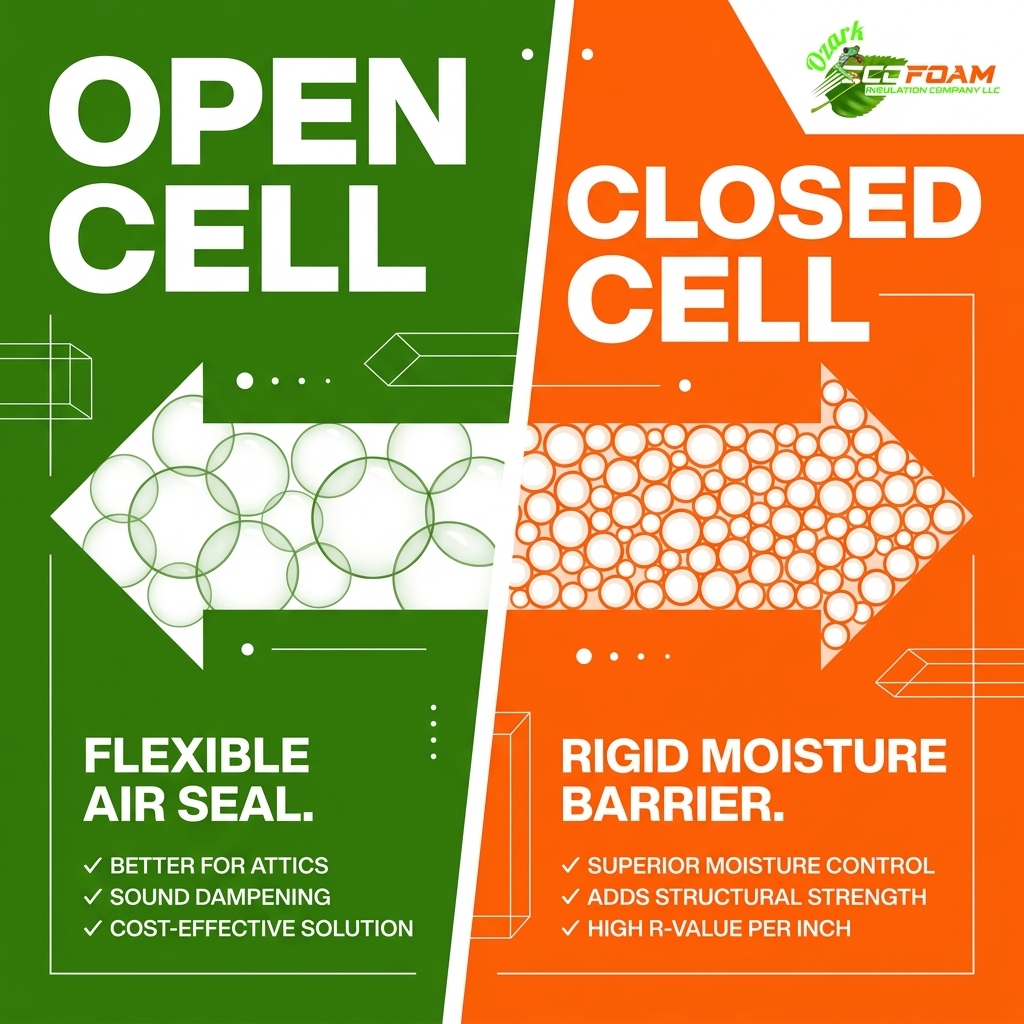
When you’re building from the ground up, you have a chance to get the building envelope right from the start. Spray foam insulation is one of the most effective ways to create a tight, energy-efficient structure that will be comfortable for years to come. But that leads to the big question: should you use open-cell or closed-cell spray foam?
The honest answer is, it depends. Every part of a building has a different job, and the right insulation matches the specific needs of that space. At Ozark Eco Foam, we help builders and property owners across Galena, KS, and the Four State area choose the right foam for the right job, ensuring long-term performance and value.
What is Open-Cell Spray Foam?
Think of open-cell foam as a dense sponge. It’s a lighter, more flexible foam that expands significantly after it’s applied. The cells within the foam are left open, which gives it its unique characteristics.
It’s an excellent choice for air sealing and sound dampening, creating a quiet, draft-free indoor environment. Because it’s flexible, it moves with a building as it settles over time without cracking or pulling away from the studs.
Key Benefits of Open-Cell Foam:
- Excellent Air Barrier: It expands to fill every crack and gap, stopping air leaks far more effectively than traditional insulation.
- Great Sound Dampening: The soft, open-celled structure absorbs sound waves, making it ideal for reducing noise between rooms and from the outside.
- Cost-Effective: Generally, open-cell foam is less expensive per board foot than closed-cell foam, making it a great value for filling large wall cavities or roof decks.
Best for: Interior walls, attic roof decks, and areas where sound control is a priority.
What is Closed-Cell Spray Foam?
Closed-cell foam is a different beast altogether. It’s dense, rigid, and incredibly strong. During the application process, the cells in the foam are pressed together and sealed, trapping a blowing agent that gives it a higher R-value per inch. This density is what makes it a powerhouse performer in specific applications.
Its rigid structure not only insulates but also adds structural integrity to walls and roofs. More importantly, its closed-cell nature makes it highly resistant to moisture. This is why the industry relies on it for tough jobs; in fact, the closed-cell segment is projected to hold a dominant market share of 62.7% by 2026, largely due to its value as a moisture barrier and its structural rigidity, according to Coherent Market Insights (2026).
Key Benefits of Closed-Cell Foam:
- High R-Value: It provides more insulation in less space, making it perfect for builds where you want maximum thermal performance without sacrificing interior square footage.
- Moisture Barrier: The closed cells don’t absorb water, making it a true vapor barrier that helps protect your building from moisture and condensation—a must for crawl spaces and metal buildings.
- Structural Strength: It acts like a glue, bonding to and reinforcing the surfaces it’s applied to, which can increase the racking strength of a wall assembly.
Best for: Exterior walls, crawl spaces, foundation walls, metal buildings, pole barns, and any area exposed to potential moisture.
Matching the Foam to the Job in New Construction
So, where does each type of foam fit into your new construction project?
For Whole-Home Air Sealing & Comfort
If your primary goal is to create a tight building envelope and reduce drafts throughout the living space, open-cell foam applied in the wall cavities and under the roof deck is a tough, cost-effective solution. It seals the building tight and provides excellent thermal and acoustic comfort.
For Moisture Control & Durability
In the Four State area, managing moisture is critical. For crawl spaces, foundation walls, and the interior of metal buildings or pole barns, closed-cell foam is the clear winner. It creates a seamless barrier that stops condensation and ground moisture from getting into your structure, protecting your investment from the inside out.
For High-Performance Building Designs
When you need the highest R-value possible in a standard 2×4 or 2×6 wall, closed-cell foam is the answer. It helps you meet or exceed modern energy codes without having to build thicker walls, giving you top-tier efficiency.
Precision Application for a Smooth Build
In new construction, scheduling is everything. The last thing you need is a sloppy insulation job that holds up the plumbers, electricians, or drywall crew. At Ozark Eco Foam, we pride ourselves on clean, precise application. We do the job right the first time, protecting windows, studs, and concrete so the next trade can keep moving without delays.
A tighter, more efficient building starts with choosing the right insulation—and the right contractor. For builders and homeowners in Galena, KS, Joplin, Pittsburg, and across the Four State area, Ozark Eco Foam has the expertise to help you build it right from the start.
Get Your New Construction Project Sealed Right
Contact Ozark Eco Foam to discuss the right spray foam insulation for your building’s comfort, efficiency, and long-term protection.
Website: https://ozarkecofoam.com/
Get a QUote
Our Posts
Crawl Space Insulation Air Quality
Crawl Space Insulation Indoor Air Quality
Commercial Spray Foam Insulation
Insulation Removal Spray Foam Upgrade Galena Ks
Spray Foam Insulation Agricultural Buildings
Open Cell Vs Closed Cell Foam New Construction
- Increase TextIncrease Text
- Decrease TextDecrease Text
- GrayscaleGrayscale
- High ContrastHigh Contrast
- Negative ContrastNegative Contrast
- Light BackgroundLight Background
- Links UnderlineLinks Underline
- Readable FontReadable Font
- Reset Reset